What is Control Engineering and Why is it Important?
Control engineering plays a vital role in modern technology. It involves designing systems that manage dynamic processes efficiently. According to a recent report by MarketsandMarkets, the global control engineering market is expected to reach $27 billion by 2026. This growth highlights the sector’s increasing importance in various industries, from manufacturing to aerospace.
Expert Dr. Sarah Thompson, a leading figure in control engineering, emphasizes its significance: “Control engineering is essential for enhancing system efficiency and reliability.” Her insights reflect a growing recognition of the discipline in optimizing operations and reducing costs. Companies that leverage control engineering techniques often achieve significant improvements in productivity.
Despite these advancements, challenges remain. Many organizations struggle to integrate new technologies into existing systems. Resistance to change and a lack of skilled professionals can hinder progress. Addressing these issues is crucial for the future of control engineering. By fostering innovation and training new talent, the industry can continue to thrive.

Definition of Control Engineering and Its Scope
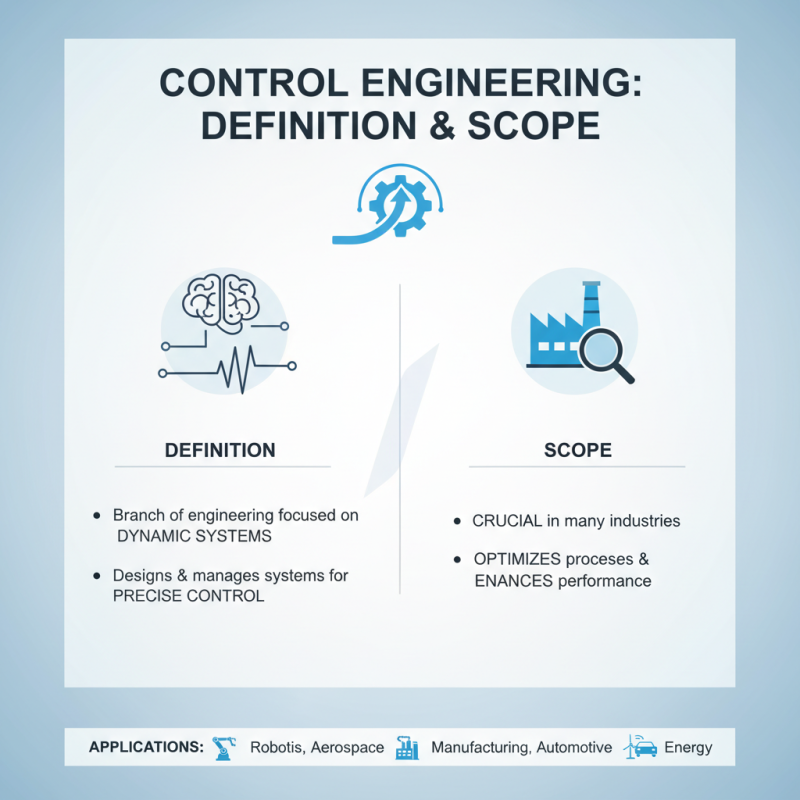
Control engineering is a branch of engineering that focuses on the behavior of dynamic systems. It involves designing and managing systems that require precise control to function effectively. In many industries, control engineering is crucial for optimizing processes and enhancing performance.
The scope of control engineering is vast. It encompasses various fields, such as robotics, automation, aerospace, and manufacturing. Engineers in this domain use mathematical models to predict system behavior. They work on feedback systems that adjust parameters in real time. This practical aspect is essential for maintaining efficiency and safety in operations.
However, the challenges are significant. Creating reliable control systems is often complex. Engineers must account for uncertainties and variations in system behavior. Overlooking small details can lead to failures. Continuous learning and adaptation are vital. Each project offers new insights and learning opportunities, reinforcing the importance of this field.
Key Components and Principles of Control Systems
Control systems play a crucial role in modern engineering. They are designed to manage and regulate dynamic systems. This management is achieved through feedback loops and control algorithms. These components ensure systems behave in a desired manner. For example, consider temperature control in a building. Sensors detect temperature changes, and control systems adjust heating or cooling accordingly.
A key principle of control engineering is stability. A stable system responds predictably to changes. However, achieving stability can be challenging. Not all systems are inherently stable. Disturbances can disrupt performance. Designers must consider these issues. Robust control strategies often need careful tuning. There’s an inherent complexity in predicting system behavior.
Another vital component is feedback. Feedback loops help systems self-correct. In a car, for instance, a speed sensor provides real-time data. This information helps maintain a steady speed, improving safety and efficiency. Without effective feedback, systems can become erratic or inefficient. Engineers must always evaluate feedback effectiveness. The relationship between components is complex and sometimes unpredictable. Continuous adjustment and optimization are necessary.
What is Control Engineering and Why is it Important? - Key Components and Principles of Control Systems
| Component |
Description |
Importance |
| Sensors |
Devices that measure physical quantities such as temperature, pressure, or flow. |
Critical for providing real-time feedback to control systems. |
| Controllers |
Devices or algorithms that determine the control actions based on sensor inputs. |
Essential for processing data and executing control strategies. |
| Actuators |
Devices that carry out the control actions determined by the controllers. |
Important for influencing physical processes in tangible ways. |
| Feedback Loops |
System pathways that return data to the controller to adjust control actions. |
Crucial for maintaining stability and accuracy in control systems. |
| Control Algorithms |
Mathematical formulas and strategies used to define how control tasks are performed. |
Fundamental in ensuring the system behaves as desired under various conditions. |
Applications of Control Engineering in Various Industries
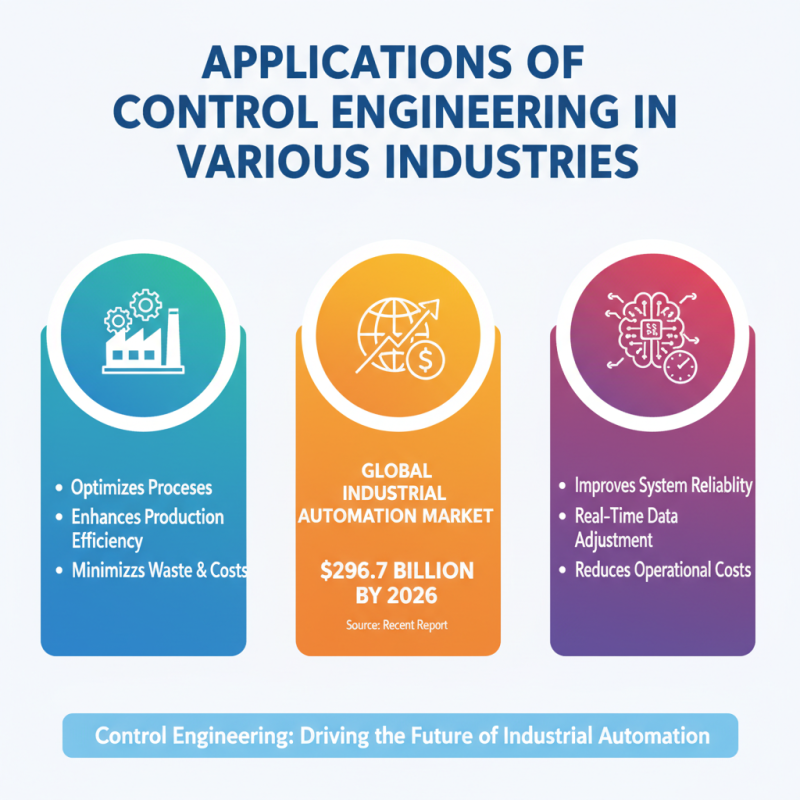
Control engineering plays a vital role in a variety of industries by optimizing processes and improving system reliability. In the manufacturing sector, for instance, control systems enhance production efficiency. A recent report indicated that the global industrial automation market will reach $296.7 billion by 2026, highlighting the importance of control engineering. Many factories utilize real-time data to adjust operations, which minimizes waste and reduces costs.
Transportation is another critical area where control engineering applies. Smart traffic management systems employ advanced algorithms to manage vehicle flow, improving safety and reducing congestion. According to a study by the International Transportation Forum, implementing these systems can decrease travel times by up to 20%. However, the reliance on technology raises concerns about system vulnerabilities and data privacy.
In the energy sector, control engineering is key for optimizing renewable energy sources. For example, wind farms use control systems to adjust turbine operations based on wind conditions. This adaptability can enhance energy output by up to 10%. Despite these advancements, the integration of various energy sources poses challenges. Balancing demand and supply remains a complex task. As industries continue to evolve, reflecting on these complexities is essential for further progress.
The Importance of Control Engineering in Modern Technology
Control engineering plays a crucial role in modern technology. It focuses on the behavior of dynamical systems. By designing controllers for systems, engineers ensure stability and optimize performance. This discipline is pivotal in various sectors, including manufacturing, aerospace, and robotics.
According to a 2022 report by the International Society of Automation, about 40% of manufacturing processes use advanced control methodology. This shift enhances productivity and reduces energy consumption. For instance, automatic control systems in factories improve efficiency by 25%. However, challenges remain. Implementing these systems can be complex and costly.
In the aerospace industry, control engineering ensures safety. Autopilot systems rely on precise algorithms to maintain flight stability. A study by the Federal Aviation Administration noted that automation reduces human error by 70%. Yet, over-reliance on technology can lead to skills degradation among pilots. Striking a balance between automation and human oversight is essential for future advancements.
Impact of Control Engineering on Various Industries
Control engineering significantly impacts various industries by optimizing processes, improving efficiency, and enhancing product quality. The above chart illustrates the estimated growth impact by percentage across key sectors driven by advancements in control engineering.
Future Trends and Challenges in Control Engineering
Control engineering faces various future trends and challenges. With the rise of Industry 4.0, the integration of AI and IoT is paramount. According to a recent report by the International Society of Automation, over 40% of companies have begun implementing smart systems. This shift demands engineers who can harness these technologies effectively. Additionally, the need for cybersecurity in control systems is increasing, as threats to data integrity rise.
Another significant trend is the growing focus on sustainability. The global push for reducing carbon footprints is influencing control engineering. For instance, automation in renewable energy systems can optimize energy use. A study published by the Global Energy Institute indicates that investments in smart grid technology could account for an annual savings of $2 trillion by 2030. However, adapting current engineering practices to support these solutions is a challenge.
Challenges also lie in the evolving skill sets needed in the workforce. Engineers must stay current with rapid technological advancements. Continuous education and training are essential. Yet, there is often a gap in resources and access to training. Many engineers report feeling unprepared for the changes ahead. The control engineering field must reflect on these issues to ensure a skilled and adaptable workforce for the future.