2026 How to Implement Process Automation in Your Business?
In today's competitive landscape, process automation has emerged as a vital strategy for businesses aiming to enhance efficiency and consistency. Companies leverage technology to streamline operations, reduce human error, and allocate resources more effectively. However, implementing process automation can be daunting. Many firms rush into solutions without fully understanding their unique needs.
A successful automation strategy requires thoughtful planning. Identify which processes will benefit most from automation. Recognize the pitfalls that may arise and address them head-on. Each choice can impact organizational culture, employee morale, and overall performance. Small, incremental changes often yield better results than sweeping overhauls.
Engaging employees in the process is essential. Their insights can refine automation efforts and ensure smoother transitions. Companies must remain adaptable and ready to iteratively improve their automated systems. Process automation offers considerable potential, but its implementation should be deliberate and reflective of organizational values.

Understanding Process Automation: Definitions and Key Benefits
Understanding Process Automation: Definitions and Key Benefits
Process automation involves using technology to perform tasks without human intervention. It streamlines operations, enhances productivity, and reduces errors. According to a report by McKinsey, companies employing automation can boost productivity by up to 40%. This indicates a significant potential for businesses looking to optimize their workflows.
One key benefit of process automation is cost reduction. The Deloitte Global Outsourcing Survey indicates that 59% of companies see the most significant cost savings from automation. Automating routine tasks allows employees to focus on strategic initiatives. However, automation isn't a one-size-fits-all solution. It requires careful planning and integration into existing systems. Organizations must consider their specific needs and the technology landscape.
Moreover, automation can enhance customer satisfaction. The Forrester Research suggests that 70% of customers prioritize companies that offer seamless interactions. Automated processes can ensure faster response times, improving the overall customer experience. Yet, companies should continually assess their automation strategies. Keeping automation aligned with changing market demands is crucial for ongoing success.
2026 How to Implement Process Automation in Your Business? - Understanding Process Automation: Definitions and Key Benefits
| Aspect |
Description |
Benefits |
| Process Definition |
A systematic series of actions directed to some end. |
Clarity and efficiency in task execution. |
| Automation Tools |
Software or systems designed to perform tasks with minimal human intervention. |
Reduced operational costs and increased speed of processes. |
| Implementation Steps |
Identify processes, select tools, develop workflows, and train staff. |
Improved adoption and process performance. |
| Key Benefits |
Benefits include enhanced productivity, accuracy, and employee satisfaction. |
Better resource allocation and competitive advantage. |
| Challenges |
Resistance to change, integration issues, and initial costs. |
Identifying and mitigating risks during adoption. |
Current Trends in Process Automation: Industry Statistics and Insights
The landscape of process automation continues to evolve rapidly. Recent statistics highlight that 70% of businesses have begun to explore automation between various functions. Industries such as manufacturing and finance lead the charge. However, other sectors are not far behind, especially in areas like healthcare and retail. These trends suggest that businesses of all sizes recognize the critical need for efficiency.
Insights show that companies leveraging automation report a 30% increase in productivity. Yet, it’s essential to acknowledge the challenges. Many organizations struggle with integration. Systems can be disjointed, leading to inefficiencies. Companies must assess their existing workflows carefully before implementation. This self-reflection is crucial to avoid future roadblocks. Additionally, employee training plays a significant role, as resistance to change can hinder advancement.
Data indicates that 80% of executives view automation as a key growth driver. However, a common pitfall is focusing solely on technology without considering the human element. Overlooking staff input can foster dissent. This reality underscores the importance of a balanced approach. Engaging employees can lead to more successful automation initiatives. Businesses should strive for transparency and inclusivity in their automation journeys.
Step-by-Step Guide to Identifying Processes for Automation
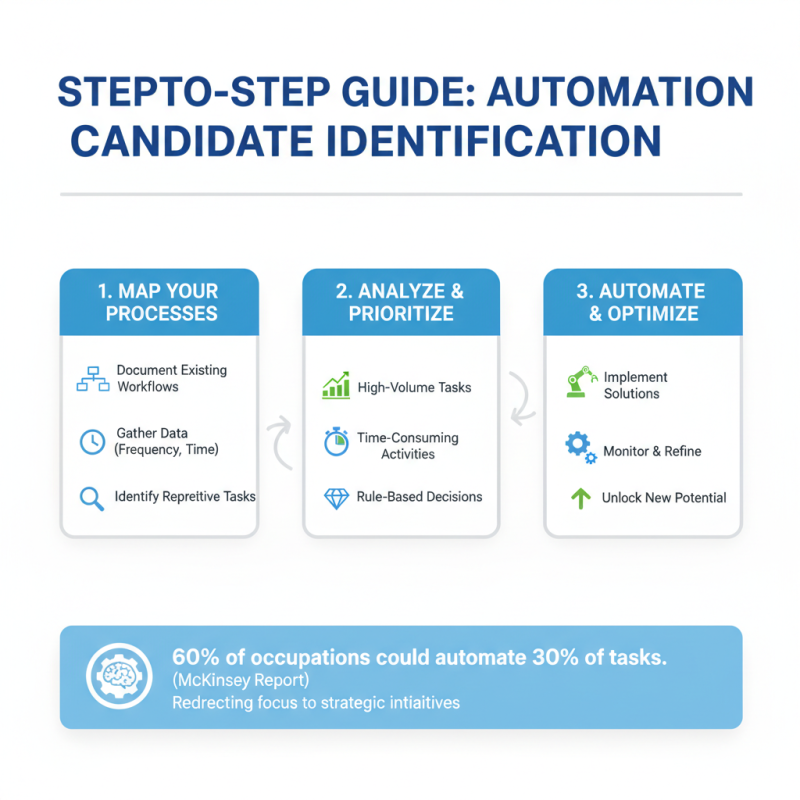
Identifying processes for automation is essential for any business. According to a report by McKinsey, 60% of occupations could see at least 30% of their tasks automated. This means a significant portion of the workforce can be redirected toward more strategic initiatives. Start by mapping out your existing processes. Gather data on task frequency and the time spent on each task. High-volume, repetitive tasks are prime candidates for automation.
Next, evaluate the impact of automation on your operations. Consider how automating certain tasks can improve efficiency and accuracy. For example, a finance department that automates invoice processing might cut processing time from days to mere hours. Industry data suggest that automation can reduce operational costs by up to 40%.
Transparency is crucial. Involve your team in the process. Seek their feedback on what tasks they find tedious or time-consuming. This collaborative approach not only helps in identifying suitable processes for automation but also addresses potential resistance. Remember, the goal is to enhance productivity without losing the human touch. Reflection on this approach is vital, as not every process should be automated. Some tasks require human judgment or creativity. Balancing efficiency with quality is key to a successful automation strategy.
Implementing Automation Tools: Choosing the Right Technologies
Choosing the right automation tools is crucial for successful implementation. Many companies struggle due to a lack of research. A recent survey by McKinsey revealed that 70% of businesses fail to scale automation. The main reason? Inadequate technology selection. Understanding your business needs is essential. Not all tools fit every organization.
When exploring automation options, consider factors like ease of integration and scalability. Industry reports indicate that 43% of companies prioritize user-friendliness. Employee training also plays a vital role. A significant portion of your team must adapt to new tools. Ignoring this can lead to frustration and reduced productivity.
Additionally, keep an eye on evolving technologies. The automation landscape changes rapidly. Relying on outdated tools could hinder growth. A Deloitte study found that 58% of organizations believe that continuous technology updates are vital for success. However, many overlook the importance of regular assessments. Your selected tools should evolve with your organization’s needs.
Measuring Success: KPIs for Assessing Automation Impact in Business
In 2026, implementing process automation requires careful consideration of key performance indicators (KPIs) to measure its impact accurately. According to a recent industry report, businesses that adopt automation can improve productivity by up to 30%. This data highlights the potential of automation but also emphasizes the need for effective tracking systems. Identifying which KPIs to use is crucial. Metrics such as process cycle time, error rates, and customer satisfaction should be prioritized.
Data shows that 70% of companies fail to realize the full benefits of automation due to inadequate measurement practices. Companies often focus on immediate cost savings, overlooking long-term impacts. Evaluating employee engagement and workflow efficiency provides a clearer picture of automation’s success. Additionally, integrating feedback loops is essential for continuous improvement. Organizations must remain agile to adjust their strategies based on real-time data.
It's also important to consider the limitations of automation. Over-reliance on technology can lead to disconnects in human touch, negatively affecting customer experience. Thus, mixing qualitative and quantitative metrics can create a balanced assessment. Keeping an eye on both the numbers and employee insights will ensure a holistic view of the automation process. As automation continues to evolve, businesses must adapt their KPIs accordingly for sustained success.
Measuring Automation Impact: Key Performance Indicators (KPIs)
This chart illustrates the expected improvement in key performance indicators (KPIs) after implementing process automation in a business. Each bar represents the percentage improvement anticipated in different areas such as cost reduction, time savings, error reduction, customer satisfaction, and employee productivity.