Top 10 Questions About Control Systems Engineering You Need to Know
Control systems engineering plays a crucial role in various industries, from manufacturing to aerospace, ensuring that systems operate efficiently and reliably. According to the International Society of Automation, the global control systems market is projected to reach $159 billion by 2026, reflecting a growing demand for expertise in this field. As industries increasingly rely on automated processes and smart technologies, understanding the fundamentals of control systems engineering becomes imperative for professionals aiming to excel in their careers.
Renowned control systems expert Dr. Emily Richards emphasizes the significance of this discipline, stating, "Control systems engineering is the backbone of modern automation, enabling us to design sophisticated systems that respond precisely to varying conditions." Her insights highlight the importance of mastering the core principles of control systems to address the complexities in today's technological landscape. With rising challenges such as system integration and optimization, the questions surrounding control systems engineering are more relevant than ever for both budding engineers and seasoned experts alike.
As we delve into the top ten questions about control systems engineering, we will uncover the essential knowledge that every engineer should possess to navigate this dynamic field effectively.

What is Control Systems Engineering? An Overview
Control Systems Engineering is a multidisciplinary field that focuses on the design and management of systems that maintain desired outputs despite variations in input conditions. At its core, it combines principles of engineering, mathematics, and systems theory to create models that predict how complex systems behave over time. This discipline is essential in various applications ranging from automotive engineering to aerospace systems, where precise control is crucial for safety and performance.
The primary objective of Control Systems Engineering is to achieve stability and efficiency in the operation of dynamic systems. Engineers in this field utilize tools such as feedback loops, sensors, and control algorithms to manipulate system behavior. By analyzing the relationship between inputs, outputs, and feedback, they can develop controllers that ensure systems respond effectively to external disturbances or changes in operating conditions. Ultimately, Control Systems Engineering plays a pivotal role in advancing technology and improving the functionality of everyday devices, making it a vital area of study for aspiring engineers.
Key Concepts in Control Systems: Feedback, Stability, and Dynamics
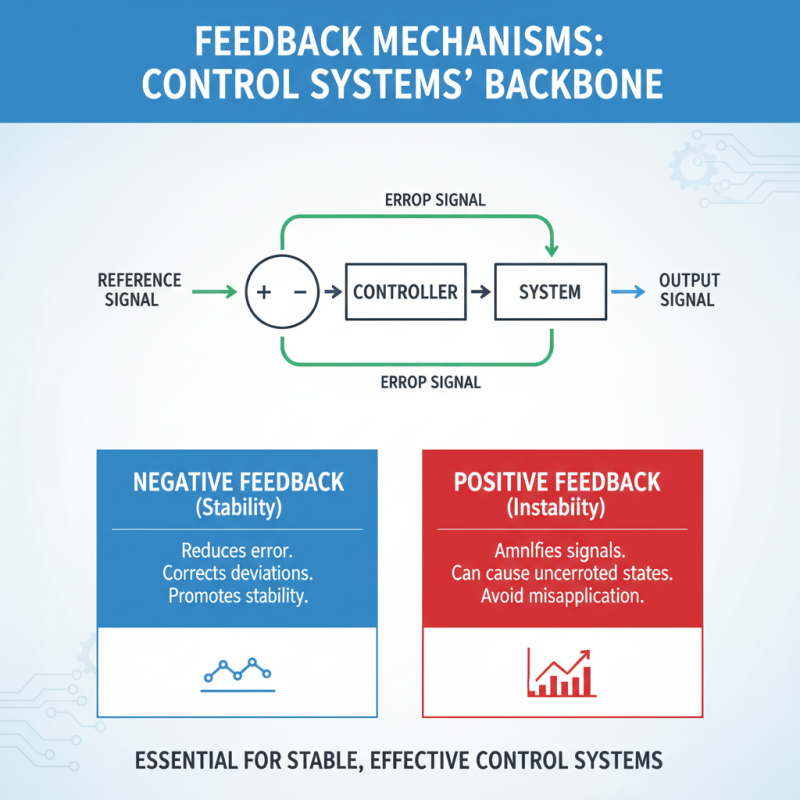
Feedback mechanisms are the backbone of control systems engineering, enabling systems to maintain desired outputs in the face of disturbances. At the core of feedback is the comparison of an output signal to a desired reference signal, which determines the necessary adjustments. Positive feedback can amplify signals, but when misapplied, it can lead to instability, causing systems to enter uncontrolled states. Negative feedback, more commonly used in control systems, helps to reduce error by automatically correcting deviations from the desired output. Understanding these feedback loops is essential for engineers to design stable and effective control systems.
Stability is a critical concept in control systems, referring to the ability of a system to return to its equilibrium state after a disturbance. A stable system will respond to changes in a predictable manner, while instability can result in oscillations or divergence from desired behavior. Engineers use various methods to analyze stability, such as the Routh-Hurwitz criteria and Nyquist plots. These tools allow engineers to predict how a system will behave over time and to make necessary adjustments in the design phase. Closely related to stability, dynamics encompasses the study of how systems change over time, influenced by factors such as inertia and damping. Mastering these concepts allows control systems engineers to design systems that are not only effective but also resilient, capable of managing real-world complexities.
Common Types of Control Systems: Open-loop vs. Closed-loop
Control systems are crucial in automating processes across various industries. Understanding the distinction between open-loop and closed-loop control systems is essential for engineers. An open-loop system operates without feedback, relying solely on the input to produce an output. This method is simpler and cheaper but can be less accurate since there is no adjustment based on the system’s actual performance. A classic example is a washing machine that runs a set cycle regardless of the cleanliness of the clothes.
In contrast, closed-loop systems incorporate feedback to adjust their operations dynamically. This feedback mechanism allows these systems to correct any deviation from the desired output, leading to greater accuracy and efficiency. Thermostats in heating systems exemplify closed-loop control; they sense the current temperature and adjust the heating accordingly to maintain the set temperature.
Tips: When designing control systems, always consider the specific requirements of the application. Open-loop systems may be suitable for straightforward tasks where precision is less critical, while closed-loop systems are ideal for processes requiring fine control. Additionally, evaluate the cost implications—sometimes, the added complexity of a closed-loop system is justified by the improvements in performance and reliability.
Essential Tools and Techniques for Control System Analysis
Control systems engineering involves analyzing and designing systems that regulate dynamic processes. A fundamental aspect of this discipline is understanding the essential tools and techniques that facilitate effective control system analysis.
State-space representation is a vital technique that provides a comprehensive approach to modeling and analyzing linear time-invariant systems. By utilizing matrices to represent system dynamics, state-space modeling allows engineers to assess system behaviors, stability, and controllability in a more versatile manner than traditional transfer function methods.
Another crucial tool in control systems engineering is the root locus technique. This graphical method assists engineers in analyzing how the roots of a system's characteristic equation change with varying feedback gain. By visualizing these changes, engineers can effectively design controllers that achieve desired performance specifications, such as stability and transient response. Additionally, frequency domain analysis, including Bode plots and Nyquist diagrams, offers insights into system performance in terms of gain and phase margins, helping engineers to ascertain stability and robustness under various operating conditions.
Together, these tools and techniques form the backbone of control system analysis, equipping engineers to solve complex problems and improve system performance.
Critical Challenges in Control Systems Engineering Today
Control systems engineering faces several critical challenges that require innovative solutions in today's rapidly evolving technological landscape. One of the primary concerns is the increasing complexity of control systems due to the integration of advanced technologies such as artificial intelligence, machine learning, and the Internet of Things (IoT). Engineers must develop systems that can effectively manage and interpret large volumes of data while maintaining reliability and responsiveness. The interaction between various components within a control system can lead to unpredictable behaviors, making it imperative for engineers to adopt robust design methodologies and testing protocols to ensure optimal performance.
Another significant challenge is the need for cybersecurity measures in control systems. As systems become more interconnected, they become more vulnerable to cyber threats, which can compromise safety and functionality. Engineers must incorporate security considerations into the design and implementation stages, ensuring that systems can withstand potential attacks without sacrificing performance. Additionally, regulatory compliance and industry standards pose challenges, as engineers must navigate an evolving landscape of guidelines and practices that govern control systems. Balancing innovation with adherence to these standards is crucial in developing effective and safe control systems that meet contemporary demands.