Industrial automation is expanding, but the right controller depends on the job, not the trend. The International Federation of Robotics’ World Robotics 2024 report estimates that 4.28 million industrial robots were operating worldwide in 2023, a 10% increase from the previous year. It also records 541,302 new robot installations that year. These figures show the scale of factory automation, but they do not measure PLC sales or prove that one PLC type suits every plant.
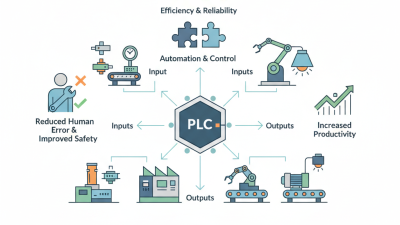
An industrial plc reads inputs, runs programmed logic, and controls equipment such as conveyors, pumps, and robot cells. Its practical value is visible in a control cabinet: available rail space, wiring access, and room for expansion can matter as much as processing speed. This guide compares common types, including compact, modular, rack-based, safety, and motion-focused PLCs. Their categories can overlap. A modular controller, for example, may also handle motion tasks.
Selection takes careful checking. Engineers typically compare I/O capacity, scan time, communication protocols, environmental limits, safety requirements, and support from the manufacturer. A small packaging machine may need a compact unit, while a large production line may call for distributed I/O and a scalable rack. Details matter. The IFR report provides useful industry context, not a PLC selection rule. That distinction is easy to miss. The sections ahead explain each type’s strengths, trade-offs, and suitable applications, while noting where a controller’s specifications should be verified against the actual machine and site conditions.
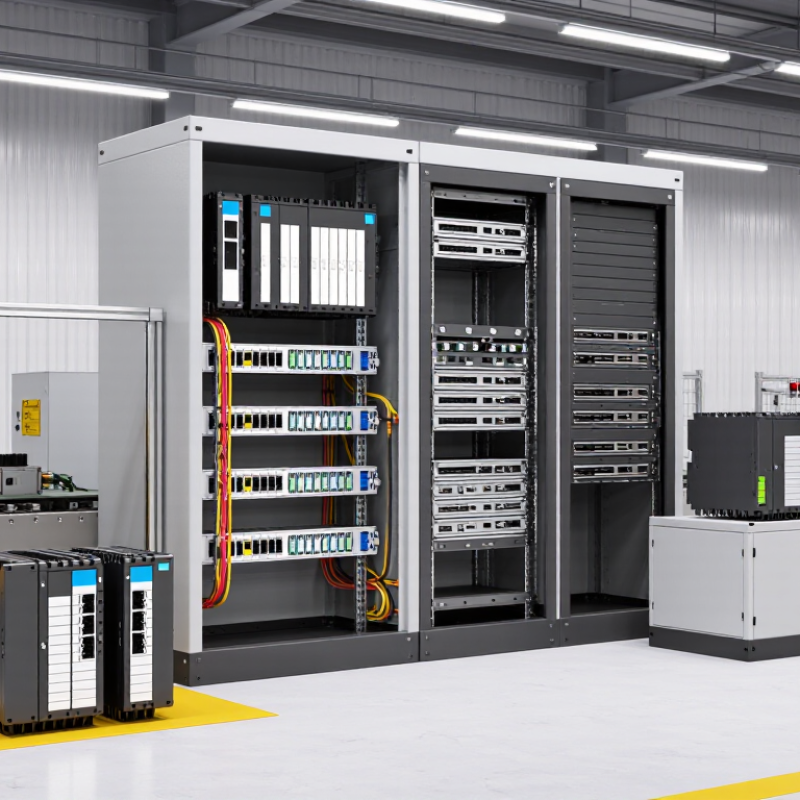
Compact PLCs combine the processor, input and output points, and sometimes a power supply in one housing. They suit small machines with predictable control tasks, such as a conveyor, pump skid, or benchtop packaging unit. On a narrow control panel, fewer separate modules can simplify mounting and reduce wiring. Less clutter.
The trade-off is limited capacity. Before choosing a unit, check the number and type of I/O points, communication ports, and available expansion modules. A machine with photoelectric sensors and a few valves may need only digital I/O; temperature probes or pressure transmitters may require analog inputs. Check scan time and high-speed counter support when timing or pulse measurement matters. Small details matter.
Compact units can also make troubleshooting less flexible if terminals are crowded or status indicators are hard to see. Leave room for cable bends and clear labels, even when the enclosure feels spacious. Verify the operating temperature and electrical ratings against the actual installation, not just the machine’s average conditions. A standard compact PLC is not automatically a safety controller. It can be tempting to select the smallest unit and move on, but future sensors or a second communication link may outgrow it sooner than expected.
Compact PLCs combine a processor, power supply, and a set of I/O in one housing. Features and I/O capacity vary by model; the ranges below are typical examples, not fixed specifications.
| Compact PLC Type | Typical I/O Configuration | Common Control Features | Suitable Applications | Key Selection Consideration |
|---|---|---|---|---|
| Fixed-I/O compact PLC | Usually about 8–40 built-in digital I/O points; some models include analog channels. | Processor, power supply, and I/O are housed together; expansion is limited or unavailable. | Small pumps, fans, simple conveyors, and standalone machines with a stable I/O list. | Count current and planned I/O before selection, including spare points for maintenance or future changes. |
| Expandable compact PLC | Built-in I/O with the option to add local expansion modules; capacity depends on the controller and module family. | Can add digital, analog, temperature, or communication modules while retaining a compact controller. | Packaging equipment, small assembly machines, and process skids that may gain sensors or actuators later. | Check the supported module count, power budget, installation space, and compatibility of the expansion system. |
| Compact PLC with mixed I/O | Combines digital inputs and outputs with a smaller number of analog channels in one unit. | Can read discrete devices such as switches and use analog signals from instruments such as pressure or temperature sensors. | Small dosing systems, temperature-controlled machines, and equipment with both on/off and measured-value control. | Match analog input type, signal range, resolution, and output type to the connected instruments. |
| Motion-capable compact PLC | Compact onboard I/O, often supplemented by high-speed inputs or dedicated motion interfaces. | May support high-speed counters, pulse-train outputs, or networked motion control, depending on the model. | Labeling machines, indexing tables, small pick-and-place systems, and single-axis positioning tasks. | Verify axis count, required speed and positioning functions, feedback-device support, and synchronization needs. |
| Safety compact PLC | Integrated standard and/or safety-related I/O, with capacity and configuration determined by the certified system. | Designed to execute specified safety functions when used within its certification limits and in a correctly engineered system. | Small machines requiring monitored guards, emergency-stop circuits, or other risk-assessed safety functions. | Confirm the required safety performance level, certified hardware and software, and applicable machine-safety requirements. |